Free Guides And Articles To Help You Build The Modern Fit Physique
Learn the important training, nutrition, and lifestyle principles and strategies that are crucial for building the Modern Fit Physique.
Upper Body Lower Body Split: 7 Great Benefits
What Is The Upper Lower Body Split
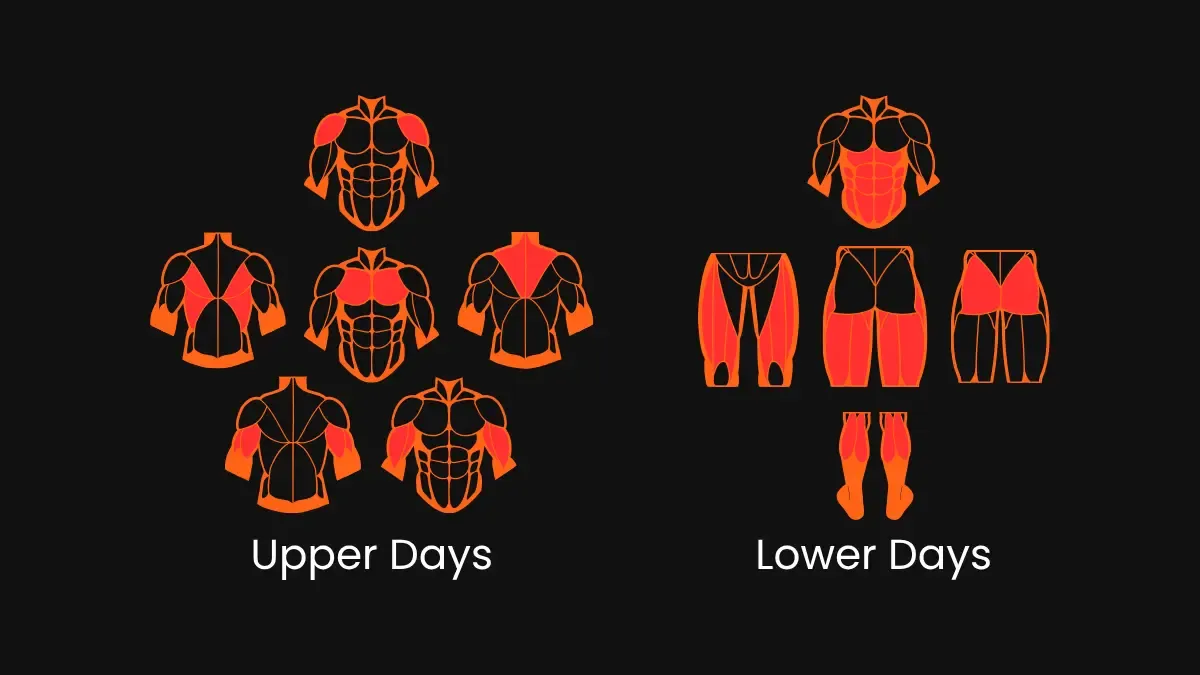
The upper lower body split is a popular training split that divides training days into working the upper body muscles and lower body muscles. On upper body days, you will train the chest, shoulders, back, biceps, and triceps. On lower body days you will train the leg muscles, such as the quadriceps, hamstrings, glutes, calves, as well as the lower back. Ab work can be trained on either day.
How To Run The Upper Lower Body Split
The upper lower split is typically run 4 days per week, with 2 days dedicated to upper body training and 2 days dedicated to lower body training, although it can also be run 5 or even 6 times per week. The default 4 days per week setup provides a twice-per-week training frequency for each muscle group.
Here are two commonly used upper lower body split setups:
Monday: Upper Body A.
Tuesday: Lower Body A.
Wednesday: Off
Thursday: Upper Body B.
Friday: Lower Body B.
Saturday: Off.
Sunday: Off.
Monday: Upper Body A.
Tuesday: Lower Body A.
Wednesday: Off
Thursday: Upper Body B.
Friday: Off.
Saturday: Lower Body B
Sunday: Off.
Lower body days are usually performed after upper body days to allow for a rest day after training legs, which is usually more stressful and requires more recovery. However, this order can be swapped around depending on what an individual is prioritising, their goals, and personal preferences.
Is The Upper Lower Body Split Effective For Building Muscle
The upper lower split can be used to build muscle (hypertrophy) or for strength. A power-building approach can also be used, performing some exercises in a lower rep range and some in a higher rep range, if your goal is to build strength and muscle. The upper lower body split can also be used in a fat loss phase to maintain muscle or even build muscle in certain situations.
As with any training split, there are pros and cons to the upper lower body split, and it may be more or less appropriate depending on an individual’s level of advancement, goals, age, and current lifestyle.
What Are The Pros Of The Upper Body Lower Body Split?
The upper body-lower body split is one of our favourite splits, and we promote it and use it frequently when building the Modern Fit Physique. Here are some of the benefits of this training split:
Effective Training Frequency
The upper lower body split provides an effective training frequency of twice per week for each muscle group. This is the sweet spot for the majority of people allowing for adequate weekly volume, while ensuring training quality and intensity remains high. Performing sets at the correct intensity will maximise the stimulus for muscle growth.
When using the 4-day upper body, lower body split, a twice-per-week training frequency can be used with only four training sessions per week, which isn't the case for other popular splits. This fits perfectly with the busy modern lifestyle where people may not have the time to train five to six times per week. They may not want to either. Twice-per-week training frequency has also been shown in research to be effective at building muscle.
Maximises Set Quality And Intensity
One benefit of the upper lower body split is that it automatically maximises set quality when set up correctly. On upper body days, we can perform a push movement for several sets followed by a pull movement for several sets. For example, we could perform 2-3 sets of the barbell bench press, followed by 2-3 sets of a barbell row. We could then move on to our second push exercise for the day followed by our second pull exercise for the day.
The benefit of this is that the chest, shoulders, and triceps have had a longer rest period between the first and second push movements of the day, as we trained a pull movement in between. This usually results in more reps being performed on the second movement and therefore more volume, compared to if we had done back-to-back pushing movements. The same will be true for our pulling movements.
Good Recovery Between Training Sessions
As we are training the upper body and lower body only twice per week, individual muscle groups will have two or three days of rest between sessions, providing ample recovery, and there is no risk of overlap between different muscle groups. Training four times per week also allows for adequate recovery in general, as it provides three rest days per week.
Joint And Connective Tissue Health
It's not only the muscles that need to recover between training sessions. When training different muscle groups, the same joints can still be used, for example, the elbow joint when performing upper body pushing and pulling movements. Since the whole upper body is trained in one session, this gives adequate recovery for these joints before the next upper body session, and the same joints are only trained two days out of the week.
Simplicity And Flexibility
The upper-lower body split is a simple split to run, which is great for beginners. As the upper and lower body are trained on separate days, there is no potential for overlap between different muscle groups, which could impair recovery. This is great for beginners and early intermediate lifters who may not have the experience or knowledge to understand how to program effectively.
The upper-lower body split is also flexible. If you are unable to train on your planned day, you can simply perform that training session the following day. Whatever session you perform, there will be no overlap with the muscle groups you trained the previous day or might train the next day.
You Can Use Antagonist Paired Super-Sets
Another benefit of the upper-lower body split is that we have the option of using antagonist-paired supersets on our upper-body days. This is where we perform a set for one muscle group followed by a set for another muscle group that performs the opposite action. An example of this would be a pushing movement such as a dumbbell chest press followed by a pulling movement such as a dumbbell chest-supported row.
The benefit of this is that we can get a lot of work done in a shorter amount of time. We can train a muscle group while another muscle group is recovering between sets, instead of waiting for 2-3 minutes between sets of the same muscle group.
We do not recommend going into the antagonist set straight after a set. Instead, we prefer to wait 45-90 seconds between sets to ensure the following antagonistic sets are of the highest quality. By the time you get back to the same muscle group, three or more minutes may have passed, which is a great way to ensure you are fully recovered and can perform a high-quality working set.
In Session Flexibility
When training in busy public gyms, it is not always possible to perform a training session in the order you have planned. Sometimes, using methods such as antagonist-paired supersets or even alternating movement patterns, as mentioned previously, is simply not possible. Luckily, the upper-lower body split has some flexibility built-in. We can simply choose which movements to perform depending on the availability of gym equipment.
Some days you may need to train back first, while on other days you may need to train chest first. If you have to perform all your push or pull movements back-to-back in one session, this is not a problem. You may lose a few reps as you will be a little more fatigued; however, losing a few reps in one session will make no difference to your results long-term.
Training major muscle groups first is not a set-in-stone rule, and it is also possible to train smaller isolation movements first. This can even be beneficial; for example, if your priority is growing your biceps, it can be a great idea to train them first when they are fresh and you have more focus. Smaller muscle groups such as the medial delts can also be trained first, and it will not affect pushing movements later in the session as the triceps are not involved in movements such as lateral raises.
Training Frequency Can Easily Be Adjusted
A training frequency of twice per week per muscle group is effective and is the sweet spot for most people; however, the upper lower body split can easily be adjusted to a higher training frequency, working the major muscle groups three times per week. This can be effective for certain individuals and certain situations. We can also reduce the training frequency to once every four to five days, depending on how we set things up.
What Are The Cons To The Upper Body Lower Body Split?
No training split is perfect, and there are a few disadvantages to running an upper-lower body training split.
Upper Body Day Session Length
One often stated complaint is that upper body days can be a little long since all the muscle groups of the upper body are trained on the same day. This will largely depend on the amount of volume you are performing over the week, so this may not be so much of a concern for individuals using a low to moderate training volume.
Smaller Muscle Groups May Receive Less Focus
In the default setup for the upper-lower body split, smaller muscle groups such as the biceps, triceps, and medial and rear delts are usually placed at the end of the workout after the main compound lifts have been performed. This will naturally result in these muscle groups being trained in a more fatigued state, so set quality will not be as high as if they were trained towards the beginning of a training session or on a separate day, such as in a body part split.
Toward the end of a training session, mental focus will likely also be lower, and these isolation exercises can sometimes be performed with less intensity, depending on the individual and how hard they are able to push themselves. These exercises can often be skipped altogether. Over time, this can result in underdeveloped arms compared to the rest of the upper body.
One possible solution to this is changing the order of exercises. Lagging or priority muscle groups can be trained before compound exercises if set up correctly.
Using Different Training Frequencies
We can use the upper-lower body split to train more or less times throughout the week, and also increase or decrease the frequency we train each muscle group. Here are some alternative set ups we like.
Three Times Per Week Alternating
If you would like a more minimalistic training split, you can perform the upper-lower body split three times per week on a rotating schedule. On week 1, you would train the upper body on Monday and Friday, with the lower body being trained on Wednesday. The following week, you train on Monday again; however, this time you start the week with the lower body. The following week would be back to the same schedule as week 1.
This is a slightly lower training frequency than twice per week and will have you hitting a muscle group once every four to five days. This can be a good option to use if you are limited in time, or you are older and fairly strong and need more time to recover between sessions.
Monday: Upper Body.
Tuesday: Off.
Wednesday: Lower Body.
Thursday: Off.
Friday: Upper Body.
Saturday: Off.
Sunday: Off
Monday: Lower Body.
Tuesday: Off.
Wednesday: Upper Body.
Thursday: Off.
Friday: Lower Body.
Saturday: Off.
Sunday: Off
Five Times Per Week With An Extra Upper Body Day
Adding a third upper body day can be a great option, which increases training frequency for upper body muscle groups to three times per week while keeping the muscles of the lower body at a twice per week training frequency. This can allow for some extra upper body volume without upper body days becoming too long. This will also give the upper body muscles three 'first touches' each week, which may be beneficial as the first set for a muscle group in each training session is the most stimulative for hypertrophy, with each following set having diminishing returns.
Some coaches believe that training frequency can be considered an independent factor, separate from volume and intensity, and not simply a way to organise weekly training volume. They argue that getting in more first sets for a muscle group each week may reduce overall weekly volume requirements. This is because we’re performing the most stimulating set for each muscle group more frequently, three times a week compared to twice.
A third upper body day could be a full upper body day or a less stressful day, for example, an arm day where more isolation work is performed for the shoulders, biceps, and triceps. You could also use a mixed approach, performing one compound push and pull movement with more or a triceps and biceps bias before moving onto your isolation work. An example of this could be performing a close-grip bench press to target the chest with more of an emphasis on the triceps, and a close-grip chin-up for the back and biceps.
Monday: Upper Body A.
Tuesday: Lower Body A.
Wednesday: Off.
Thursday: Upper Body B.
Friday: Lower Body B.
Saturday: Upper Body C.
Sunday: Off.
Monday: Upper Body A.
Tuesday: Lower Body A.
Wednesday: Off.
Thursday: Upper Body B.
Friday: Lower Body B.
Saturday: Upper Body C (Arm Focus).
Sunday: Off
Six Times Per Week
The upper-lower body split can be run six times per week in certain situations, which would give a three times per week training frequency for the muscle groups of the upper body and lower body. We find most people will not want to train their legs three times per week, which does not usually deliver any extra benefits compared to training legs twice per week, especially long-term.
We do not typically recommend this set-up, as most men will run into recovery issues training six times per week, and this is not a good fit for the busy modern lifestyle for most people. To make this work, close attention will need to be given to things such as exercise selection and intensity. This higher frequency approach could be used for a shorter period, in the right context, if set up correctly.
Monday: Upper Body A.
Tuesday: Lower Body A.
Wednesday: Upper Body B
Thursday: Lower Body B.
Friday: Upper Body C.
Saturday: Lower Body C.
Sunday: Off.
The Modified Upper Body Lower Body Split
The upper body-lower body split can be modified slightly by moving some upper body work to one or more of the lower body days, which will usually have fewer exercises. This distributes the work a little more evenly throughout our weekly training sessions. The general structure of the training split remains the same, with dedicated days to train the upper and lower body; however, some upper body work is performed on lower body days.
There is no right or wrong way to set up a modified upper-lower body split, and the setup you choose can be dictated by your goals and personal preferences. Some good options for upper body work to be performed on lower body days include:
Muscle Groups That Recover Quickly And Can Handle More Volume.
Muscle Groups That Need More Volume.
Priority Muscle Groups/Weak Points.
Here are two commonly used setups for a modified upper body, lower body split:
Move Biceps To Lower Body Days
One of the simplest modified upper-lower split setups involves moving your biceps training to your lower body days. This works quite well as they can be trained in a less fatigued state, rather than at the end of an upper body session, after you have trained pull movements which do involve some bicep work (depending on how well you perform your pulling movements).
The nice thing about this setup is that your biceps will get some indirect work on your upper body days and direct work on your lower body days. The biceps are one of those muscle groups that will recover quickly, so training back the day before biceps should not impact your biceps training, especially if you are performing back exercises correctly. Other smaller muscle groups could also be trained on lower body days, such as the side and/or rear delts. These often need more volume and also recover quickly, meaning you could perform them on back-to-back days.
Perform Some Back Work On Lower Body Days
Another modified upper-lower body setup involves performing some back work on your lower body days. The back has many different muscle groups, and performing a variety of movements emphasising different angles is often required to see the best results. The back can also handle a lot of volume.
Some good options include extra work for the upper back and traps. Another option is to perform more lat-focused work on your upper body days and more upper back and trap work on lower body days. This can work well as one of your lower body days will likely involve trap work when performing deadlift variations, for example.
If you have a specific goal, such as increasing the number of pull-ups you can perform, placing these on lower body days can also be a good option. You can train your back closer to muscular failure on your upper body days and get some extra volume in working further away from muscular failure on lower body days. This ‘greasing the groove’ approach works well for bodyweight training, as we are practising the skill and improving our strength without building up excessive fatigue throughout the week.
Do We Recommend The Upper Body Lower Body Split?
The upper-lower body split is a great training split and it may be the best split for a lot of people. It can be used by beginners, intermediates, as well as advanced lifters. Some of its main advantages are effective training frequency with adequate recovery between sessions, as well as its simplicity and flexibility. We recommend you start with the standard four-day-per-week setup, with two upper body workouts and two lower body workouts.